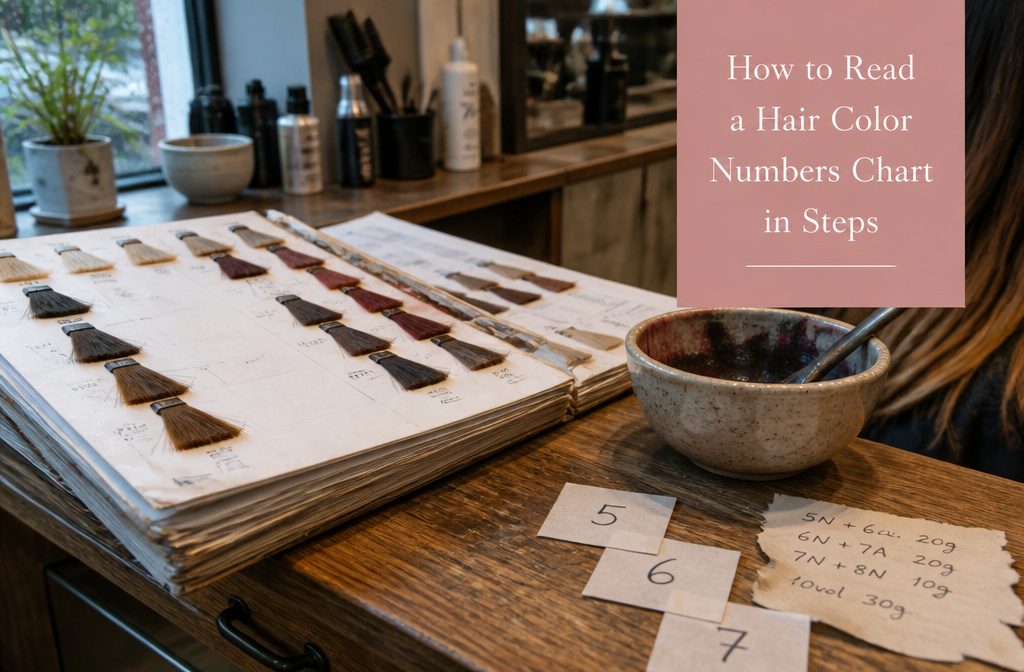
A hair color numbers chart is a coded scale that tells you how dark or light a shade runs and whether it lands warm, cool or neutral once it sets.
The same code means different things across brands: Garnier’s 6.3 is a golden level 6, Naturtint writes 5NM for neutral mahogany at level 5, and Madison Reed skips numbers entirely in favor of letters like NCR.
Most charts place level 1 at black and level 10 at the lightest blonde, with tone coded after a dot, slash or dash to show whether the dye pulls ash, gold, copper or red.
1. The First Number Is Level
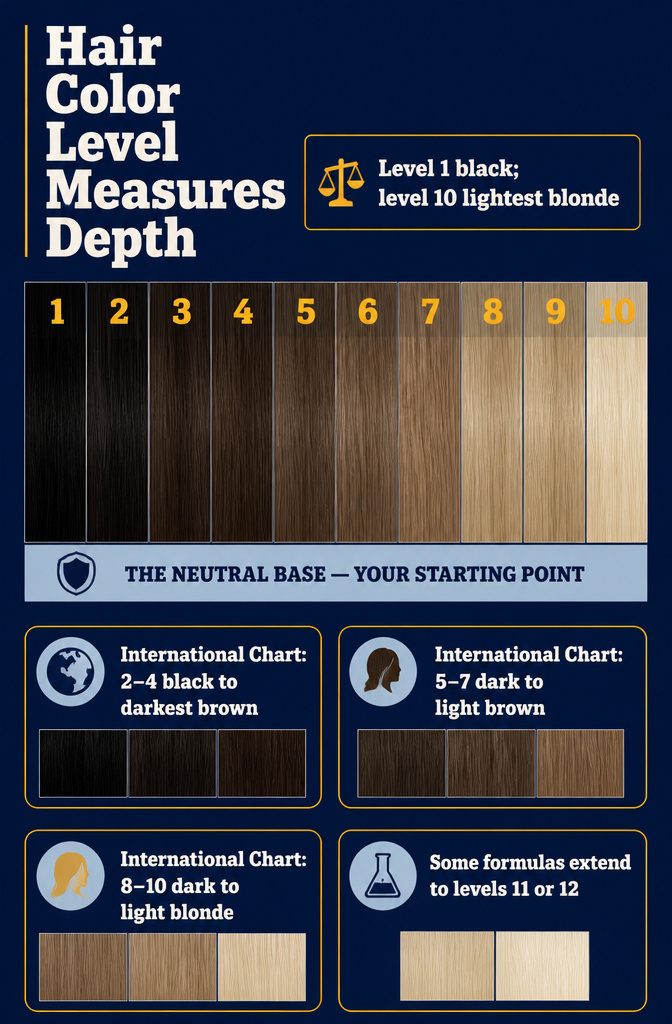
The first number in a hair color code tells you the level or depth, which measures how light or dark the shade runs on a scale where 1 is black and 10 is the lightest blonde.
Most brands follow the International Color Chart grouping: levels 2–4 cover black through darkest brown, 5–7 span dark brown through light brown, and 8–10 run from dark blonde through light blonde. Garnier divides them slightly differently at 1–3, 4–6, and 7–10, but the logic holds.
Madison Reed runs 2 to 10, skipping the deepest black that some charts start with. A few systems stretch to 11 or 12 for ultra-light or lightening formulas.
Naturtint codes its range with letters attached, running 1N Ebony Black all the way to 10N Light Dawn Blonde. The level is your starting point, a true neutral base before any warm or cool tone gets layered in.
2. Tone After the Separator
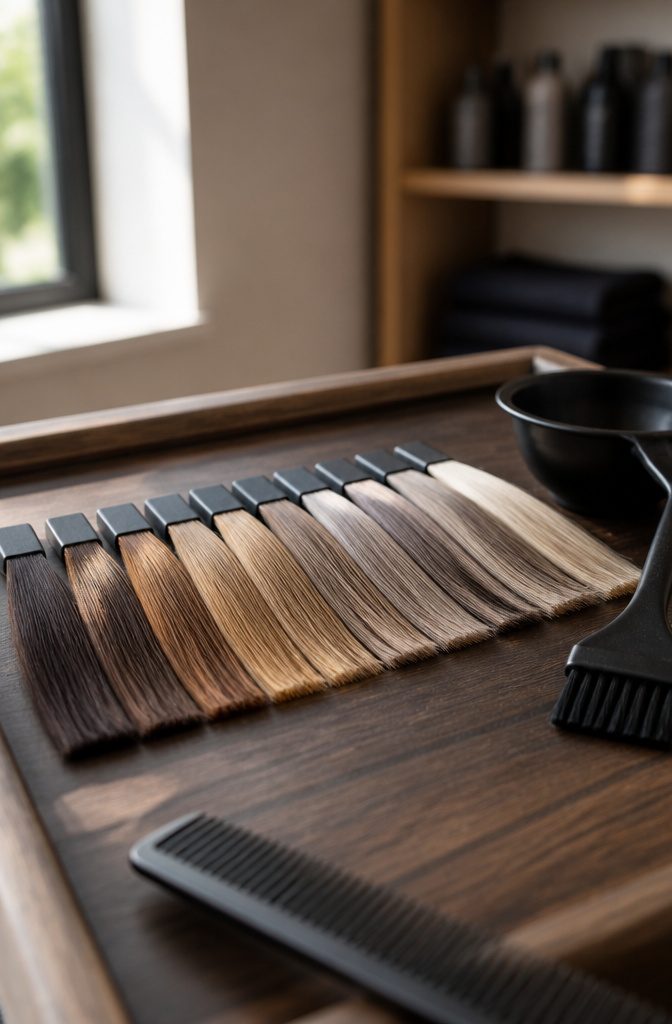
The first number after the dot, slash or dash tells you the tone, and this is what decides whether the result reads warm, cool or neutral to the eye.
Take 7.3: the 7 is medium blonde, and the .3 is golden. In Garnier’s system, 83 translates to medium golden blonde, with the 8 as level and the 3 as tone.
Luc Vincent’s 6.3 gives dark blonde with a golden reflection. Tone is how the color appears when you see it, not the depth.
Some charts write tone as a letter rather than a number, and brand names vary slightly.
Revlon’s 6.1 means dark blonde in a blue ash tone, while a 6.7 in the Neal and Wolf chart reads as dark blonde with a brunette tone. The number itself matters less than knowing what each brand calls warm versus cool.
3. Second Digits and Double Tones
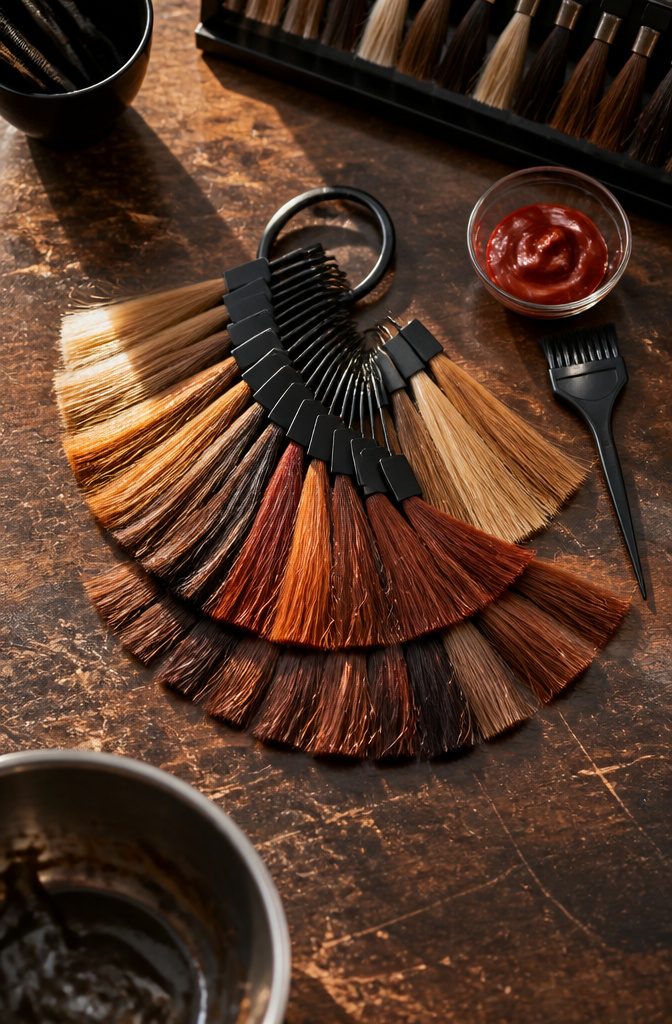
Once a shade includes more than one digit or letter after the level, the first one dominates and the later ones add quieter supporting color. Neal & Wolf puts the split at roughly 70% primary tone and 30% secondary.
Luc Vincent’s 5.34, for instance, is a light brown with gold as the main reflection and copper adding a subtle undertone. Garnier’s 535 reads as medium golden mahogany brown, where the golden tone leads and mahogany follows to deepen the result.
Double digits can signal intensity, though what that looks like depends on the brand.
Glamot’s 7/33 is an intense golden blonde, where repeating the 3 amps up the gold. Neal & Wolf follows the same pattern with colors like 77.66, an intense medium blonde with a double red tone.
Zero placement matters too. Luc Vincent says a 0 before the reflection softens it, while a 0 after intensifies it.
Glamot reads /0 as natural, a slight warm hue designed to cover grey evenly. The notation varies enough that checking the brand’s own chart is the only way to know what a double digit actually does in your box.
4. Use the Color Wheel
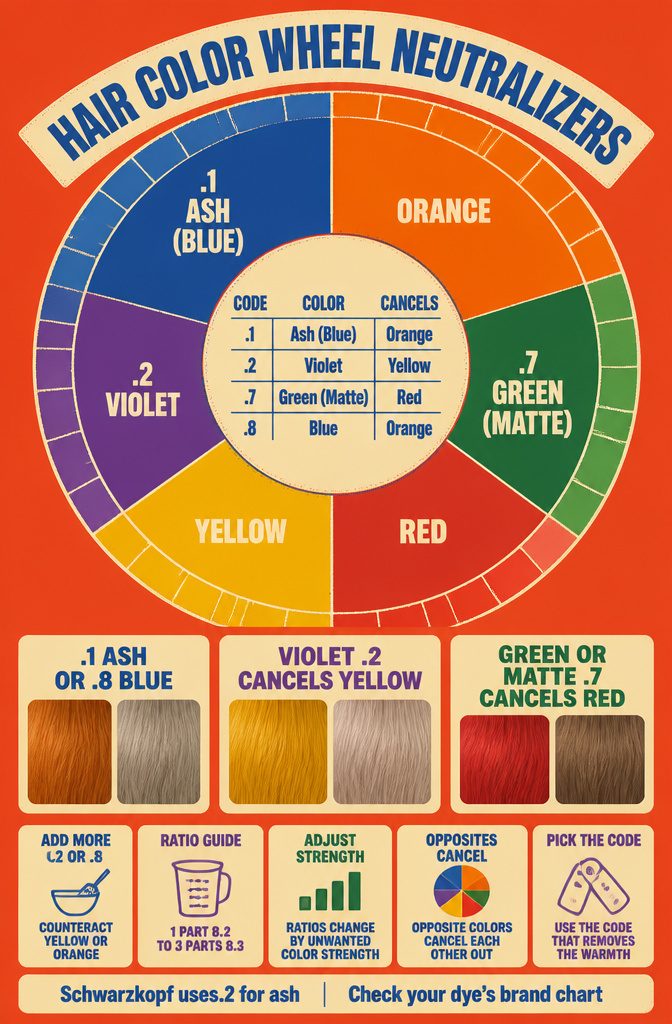
Opposite colors on the wheel cancel each other out, which means blue neutralizes orange, violet neutralizes yellow, and green or matte neutralizes red.
That principle is what lets you pick a code that removes the warmth you don’t want. If brass or yellow shows up where you wanted cool blonde, codes .1 ash and .2 violet pull it back.
For orange, .8 blue works. For red, .7 green or matte does the job.
Neal & Wolf suggests adding more .2 or .8 to counteract yellow or orange tones.
Luc Vincent mixes roughly one part 8.2 to three parts 8.3 when he wants to adjust tone. The ratios change depending on how strong the unwanted color is and how much you need to shift it.
| Code | Color | Cancels |
|---|---|---|
| .1 | Ash (Blue) | Orange |
| .2 | Violet | Yellow |
| .7 | Green (Matte) | Red |
| .8 | Blue | Orange |
Keep in mind that coding differs by brand.
Most use .1 for ash, but Schwarzkopf uses .2. Check the chart that comes with your dye rather than assuming the codes line up across brands.
5. Match the Chart to Your Roots
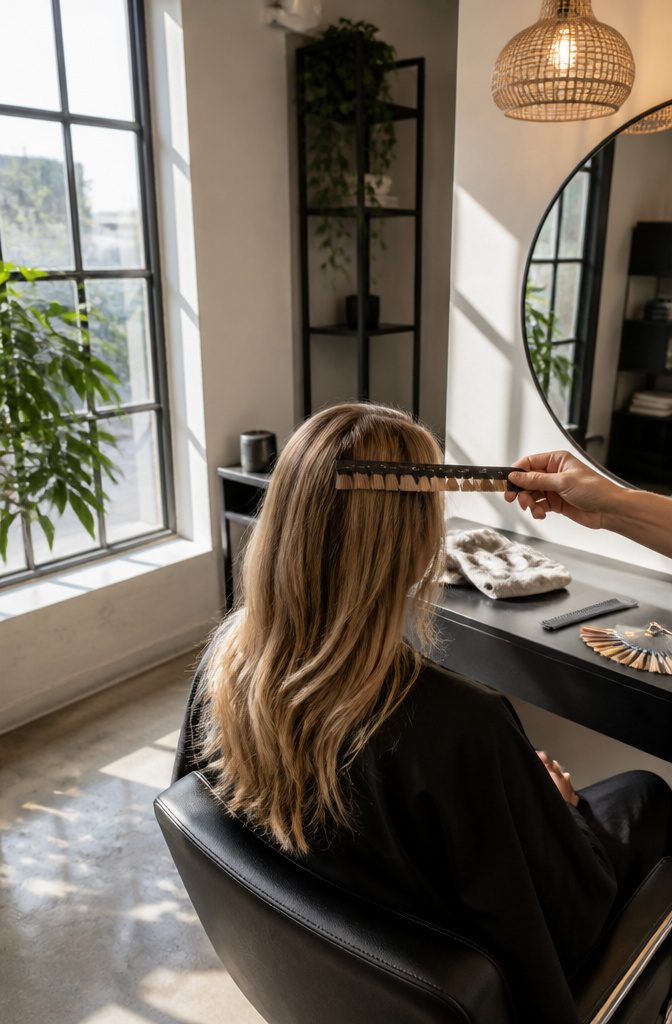
Hold your hair against the brand’s own level chart in natural daylight, not under bathroom bulbs. Indoor lighting skews darker or warmer than reality, so step near a window or outside.
Match the chart to your roots if you’re working with virgin hair, mid-lengths if you last colored months ago and that’s the section you’re treating now.
Previous dye changes the read completely. A level 7 chart swatch held against bleached ends will tell you nothing useful about what formula you actually need.
The closest match wins.
If your root sits between two swatches, go with the darker one. Hair reads lighter once dye is on, and a formula chosen for a level up tends to pull more brass than you planned for.
Garnier and Madison Reed both publish their own charts, so use the one from the brand you’re buying rather than a generic version from a different line.
6. Know Your Lift Limit
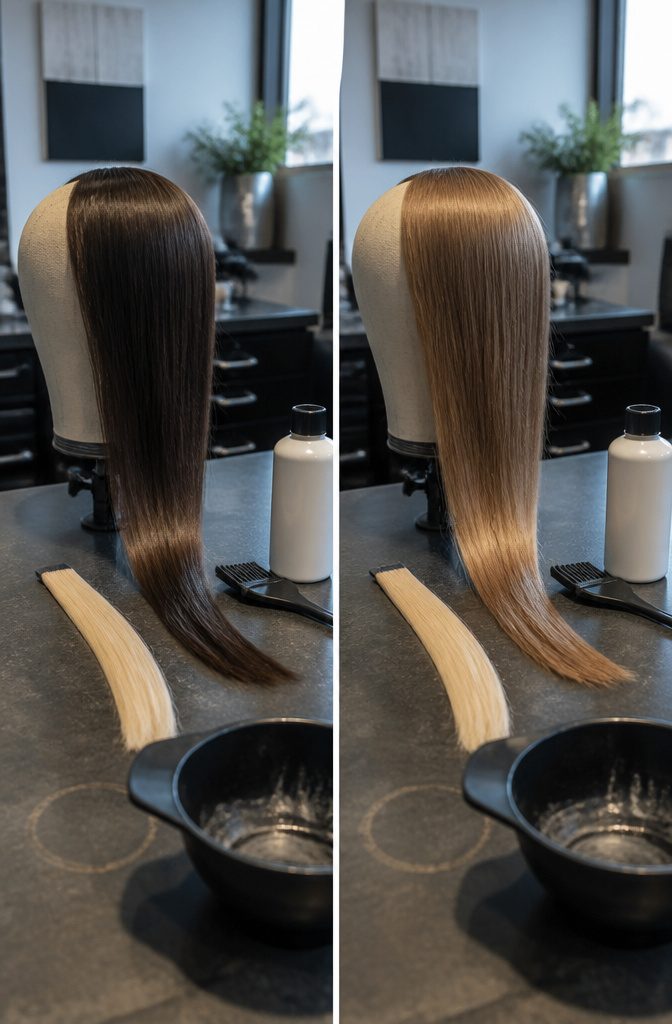
Permanent color lifts natural hair about two levels from your starting point.
Garnier holds the line at two levels lighter or darker at home, Blendsor stretches it to two or three with permanent color, and wikiHow allows three to four levels if you can tolerate the processing.
Any of those figures still means the same thing: if you start at a level 4 medium brown and reach for a level 7 medium blonde box, the math does not work.
The color sits on top doing nothing, or worse, turns brassy because it cannot pull enough pigment out.
Demi-permanent color skips lifting entirely. It deposits level and tone, so it darkens or enriches what you have but never lightens.
Permanent color also cannot lighten hair that is already colored. The rule is simple: color cannot lift color.
Major corrections belong in a salon. Garnier flags three scenarios that need professional help: lifting more than two levels without bleach, fixing patchy bleach or heavy banding, and going from dark black to light blonde in one session.
7. Match Tone to Skin Tone
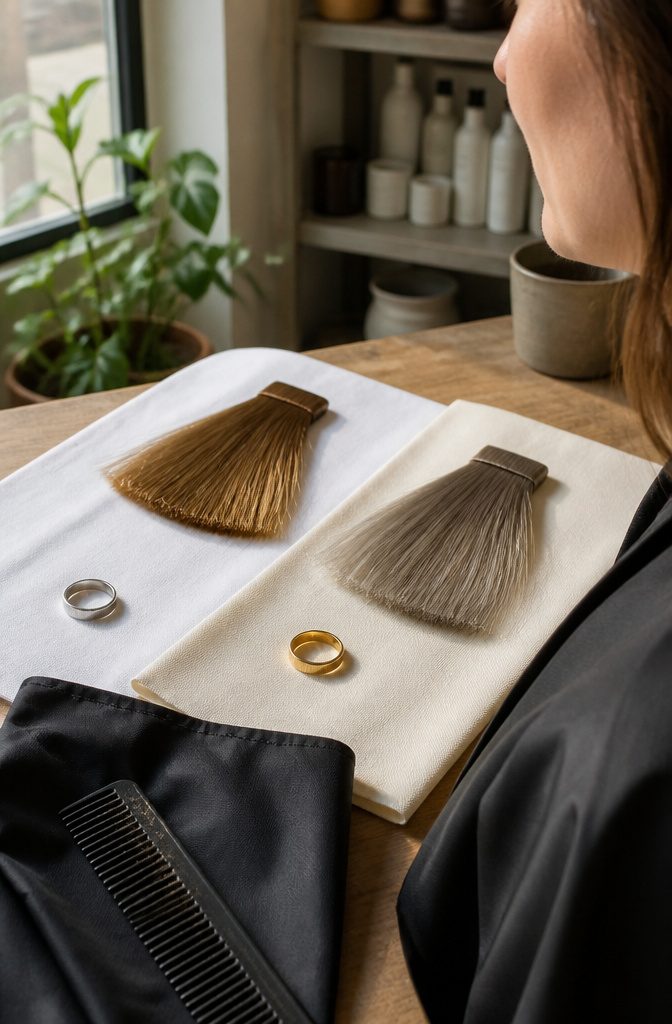
Match Tone to Skin Tone
Warm undertones pair best with warm or golden shades, cool undertones with ash and other cool shades, and neutral undertones suit a broad range.
That said, several sources treat this as a guide, not a rule—plenty of people wear the opposite beautifully, and high contrast can be striking.
Two quick tests help you identify where you sit.
The jewelry test: if silver flatters you, you lean cool; if gold does, you lean warm. Both look nice?
You’re likely neutral. The white fabric test runs the same way.
Hold pure white and cream next to your face in natural light. Pure white brightens cool skin; cream flatters warm.
Once you know your natural base and undertone, you can decide whether to enhance them or adjust. Warm tones add color and richness.
Cool tones reduce the look of redness and keep brass in check. Neutral tones sit between the two, the safe pick when you’re not sure which direction to go.
8. Test Before You Commit

A shade swatch doesn’t tell you much about how it will sit on your own hair. Run a few checks before you buy.
- Do a strand test if you already have the dye. Mix a small amount, apply it to a section underneath where it won’t show, and see what develops. A professional swatch chart shows each number on uniform hair, but your current color and texture change the outcome.
- Try a virtual try-on tool. Madison Reed’s lets you upload a selfie or use your phone camera to compare shades in real time. Garnier offers the same. Hold a cool blonde next to a warm one on your own face, not a model’s.
- Take a quiz. Madison Reed’s and Garnier’s shade selector both narrow the chart based on your current color and your goal.
- Book a consultation. Madison Reed’s concierge connects you with a licensed colorist. If you’re between two numbers or unsure what tone will read on you, ask before you mix.
Madison Reed backs the first box with a 100% money-back guarantee within 60 days if the shade doesn’t work.
Level Versus Tone
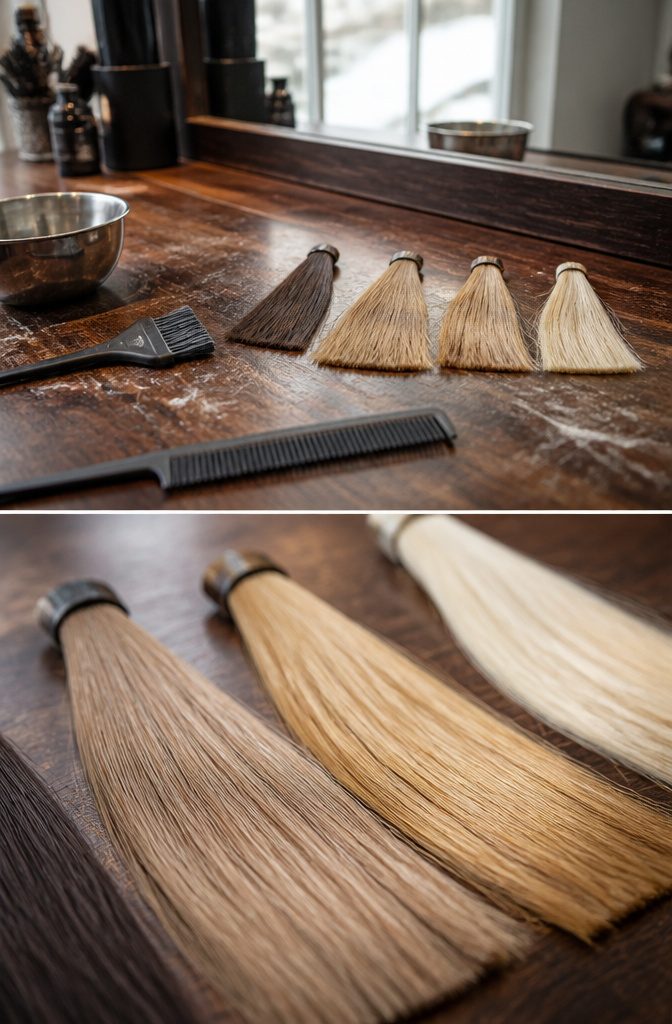
Level measures depth only: 1 is black and 10 is extra light blonde. Tone is the hue sitting on top of that depth, and a shade is the two together.
A 7/1 and a 7/3 are equally light, yet one is ash and the other golden, so two boxes with the same first number can look nothing alike. The same level can land on ash, golden, copper, violet or red.
Read a code like 83 as level 8, tone 3: a medium golden blonde.
I check the tone before the level every time. A level 7 that runs copper will look far warmer on your head than the ash level 7 beside it on the shelf, even though the depth is identical.
Brand Codes Differ
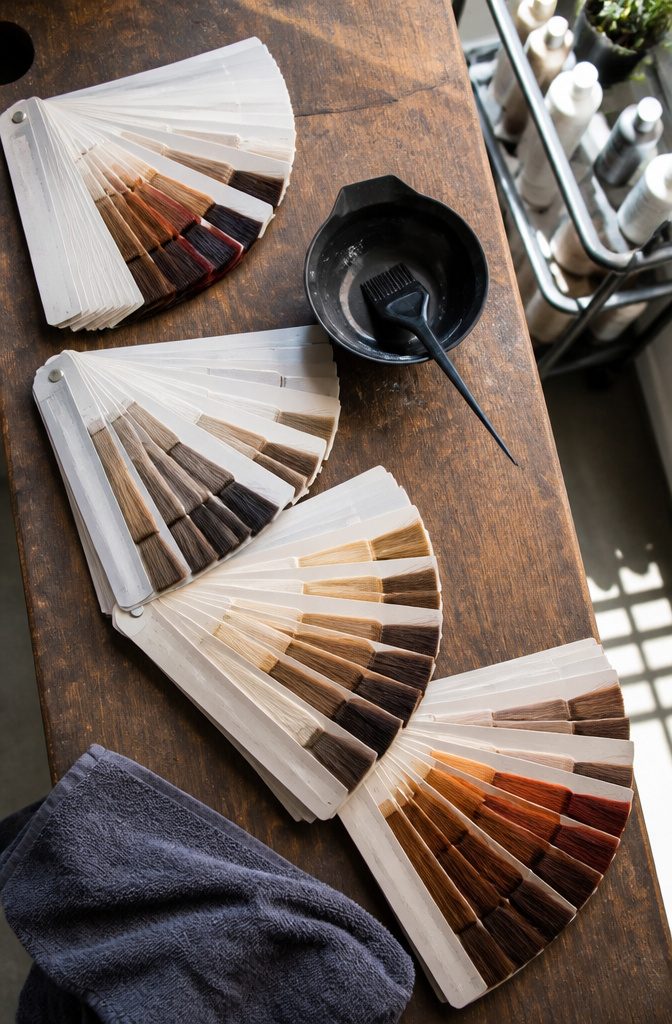
The level scale is broadly shared across brands, but tone codes, letters, separators and names vary by manufacturer, so identical codes do not mean identical colors.
Madison Reed uses letters: N for neutral, A for ash, V for violet, G for gold, C for copper, R for red, M for mahogany.
Garnier uses digits after the level, where 3 signals warm, 1 signals cool, and 0 signals neutral. Glamot writes slash and comma styles like 7/22 and 8,34.
Naturtint runs 1N to 10N for natural tones, with combinations like GA for gold ash and NM for neutral mahogany. Revlon lists reflects as .1 to .9 after the level.
| Brand | Tone System | Example Code | Meaning |
|---|---|---|---|
| Madison Reed | Letters (N, A, V, G, C, R, M) | 7NCR | Level 7, neutral copper red |
| Garnier | Digits (0 neutral, 1 cool, 3 warm) | 6.3 | Level 6, golden tone |
| Naturtint | Letter pairs (N, GA, WB, NV) | 5NM | Level 5, neutral mahogany |
| Glamot | Slash or comma + letters | 9/AV | Very light blonde, ash violet |
Check the specific brand’s chart before you buy, because a 6.3 in one line will not match a 6.3 in another.
Underlying Pigment by Level
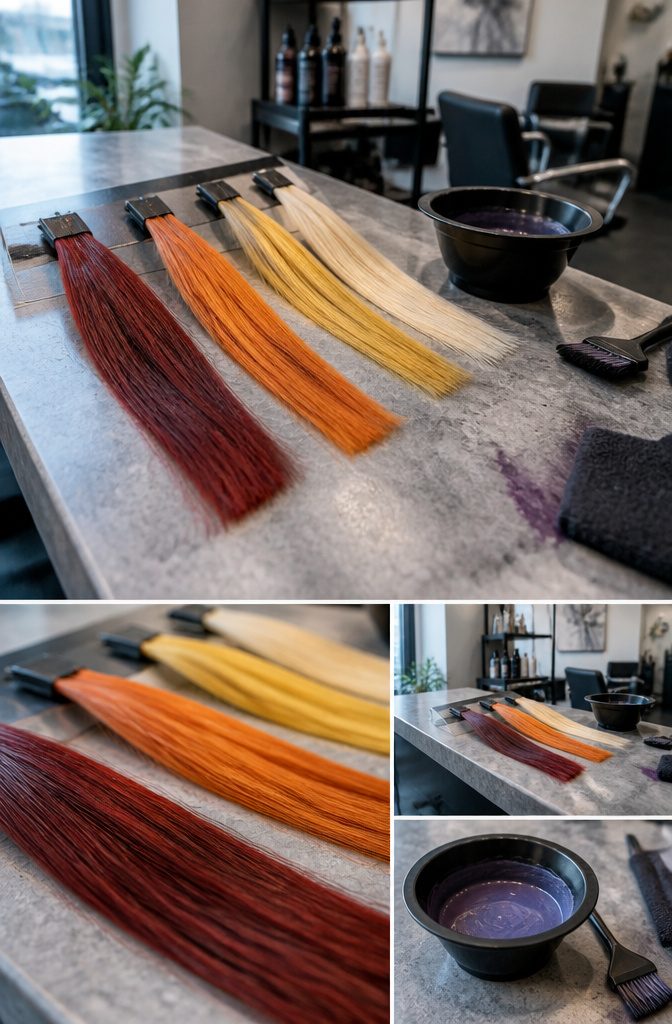
Lightening hair pulls warm pigment to the surface in a predictable sequence. At level 3, you see dark red.
By level 6, that red has shifted to orange. Level 7 brings orange-yellow, and by the time you reach level 10, the pigment left behind is pale yellow.
This progression matters because it tells you which corrector to reach for when those warm tones show up.
Orange on a brunette lifting to blonde means you need violet to cancel it. Yellow at the higher levels calls for the same family, just lighter in intensity.
The underlying pigment is not random. It follows the same path every time, which means you can predict what you will need to neutralize before you even start mixing.
Warm, Cool and Neutral Families
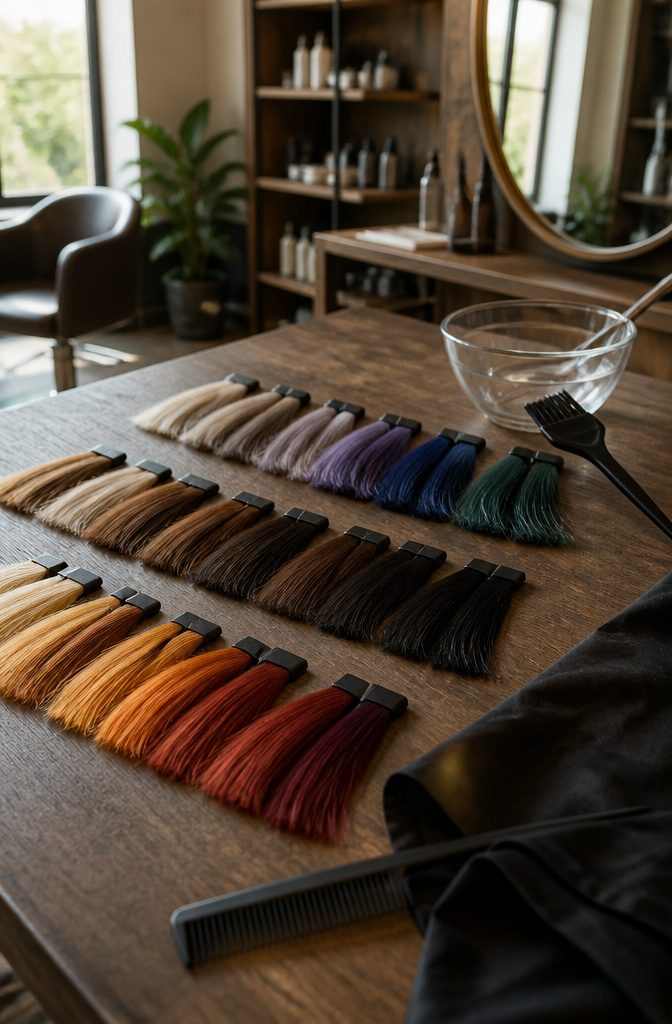
The tone families tell you whether the dye pulls warm, cool or neutral once it sets. Warm tones cover gold, copper and red—Revlon marks those .3, .4 and .6—and they bring yellow, orange and mahogany into the base.
Cool tones run ash, violet, blue and matte green—.1, .2, .7, .8 and .9 in the Revlon system—and they knock back brassiness when you lift or neutralize orange in brunette bases.
Natural or neutral tones, usually marked .0 or written with no decimal at all, sit in the middle without leaning either direction.
Blendsor runs .0 through .7 and names them differently: .1 is ash with a blue base, .3 is golden with yellow, .7 is matte with green to cancel red.
The numbers stay fairly consistent across brands, but the names shift. Schwarzkopf inverts some codes, so matching a chart to the box you bought matters more than memorizing one system and assuming it travels.
Gray Coverage Needs N
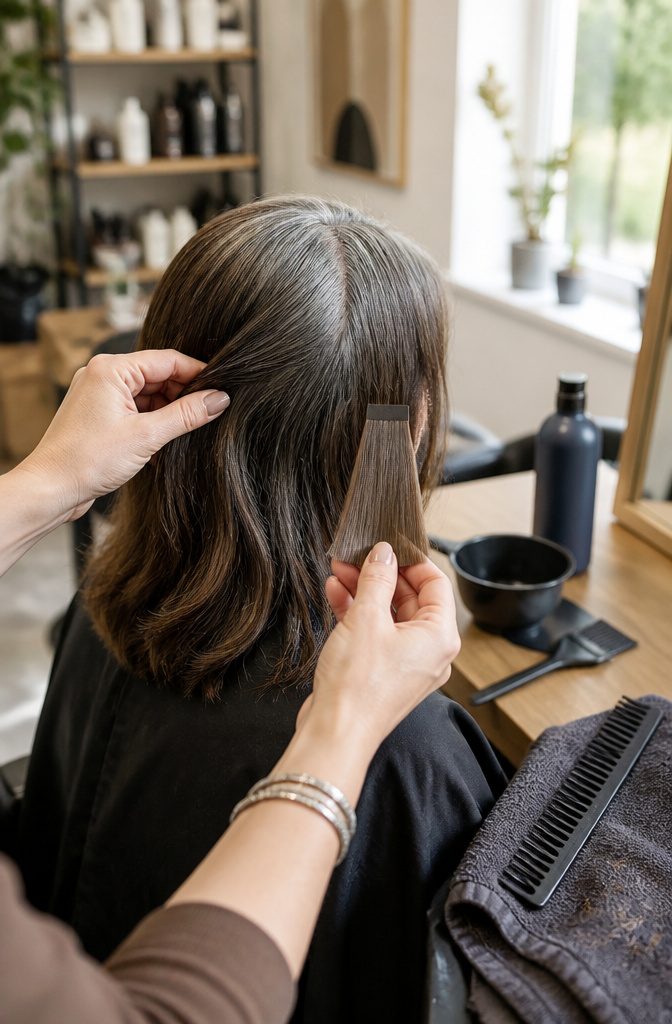
If gray coverage is part of the job, the formula needs N for natural or neutral.
Madison Reed builds extra N into shades designed for stubborn gray, Naturtint calls N the best choice for uniform results, and Garnier steers you toward neutral tones ending in .0.
The logic is simple: gray hair has no pigment left, so it pulls dye faster and harder than the rest of your head.
Bright or warm tones can look patchy or artificial where the gray was. Neutral shades carry a balance of warm and cool pigment that blends gray and natural color into one consistent result.
The upkeep calendar runs tighter than you might expect.
Garnier recommends a full recolor every 4–6 weeks to cover root regrowth, and toning every 2–3 weeks if brassiness shows up or the color starts looking flat. That makes neutral coverage a rhythm, not a one-time fix.
Developer Volumes
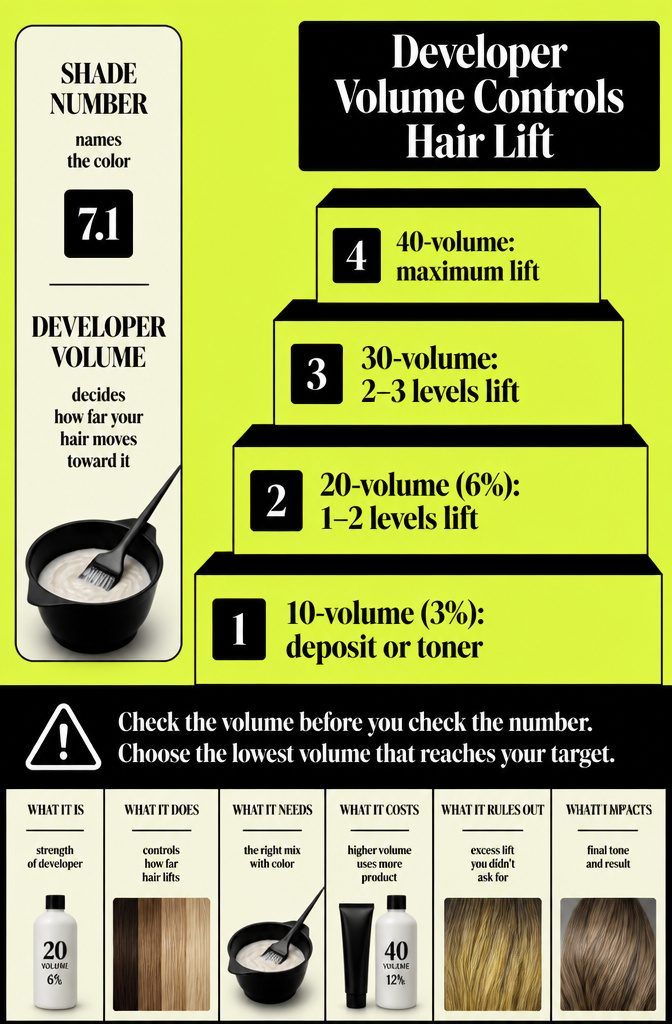
The shade number names the color, but the developer you mix it with decides how far your hair moves toward it. Blendsor’s four volumes split the work like this:
| Developer | Best for |
|---|---|
| 10-volume (3%) | Color deposit or toner |
| 20-volume (6%) | 1–2 levels of lift |
| 30-volume | 2–3 levels of lift |
| 40-volume | Maximum lift |
The same shade mixed with 20-volume and with 40-volume will not land in the same place, so check the volume before you check the number.
I’d pick the lowest developer that reaches your target level. Going higher than the job calls for only adds lift you didn’t ask for.
Frequently Asked Questions
What do the numbers and letters on hair color mean?
The first number is the level, which tells you how light or dark the shade is, from 1 (black) to 10 (lightest blonde).
The digits or letters after the dot, slash or dash name the tone, such as gold, ash or copper, and any extra digits add quieter supporting color. A code like 83 reads as level 8, tone 3: a medium golden blonde.
What is a hair color level and how do levels work?
A level measures the depth of a shade on a 1–10 scale that runs dark to light.
Most brands follow the International Color Chart: levels 2–4 cover black through darkest brown, 5–7 run dark brown through light brown, and 8–10 run dark blonde through light blonde. Garnier splits the scale at 1–3, 4–6 and 7–10, and some lightening formulas go up to 11 or 12.
Which hair color is lighter, a 7 or an 8?
An 8 is lighter, because a higher level number always means a lighter shade.
By the same rule, a 2 is darker than a 4. Compare only the first number for depth; the tone digits that follow change the hue, not how light the color is.
Are hair color numbers the same across brands?
The level scale is broadly shared, but tone codes, letters and separators vary by manufacturer.
Most brands use .1 for ash, for example, while Schwarzkopf uses .2. A 6.3 in one line will not match a 6.3 in another, so read the chart for the brand on your box.
How do I find my hair color level?
Hold your hair against the brand’s own level chart in natural daylight, not bathroom lighting.
Match the chart to your roots if your hair is virgin, or to your mid-lengths if you colored it months ago and that is the section you are treating.
If your hair falls between two swatches, go with the darker one.
How do I cancel brass or orange tones?
Pick the opposite color on the color wheel: blue cancels orange, violet cancels yellow, and green (matte) cancels red.
In code terms, .1 ash and .2 violet pull back brass, .8 blue handles orange, and .7 green handles red. Check your brand’s chart first, since the digits are not the same everywhere.
What undertone shows up at each level when hair is lightened?
Warm pigment surfaces in a set order as you lift.
Level 3 reveals dark red, level 6 shows orange, level 7 brings orange-yellow, and by level 10 the leftover pigment is pale yellow. That order tells you which corrector to use, such as violet for the orange and yellow that appear at lighter levels.
How many levels can I lighten my hair at home?
Plan on about 2 levels with permanent color. Some sources stretch that to 3 if your hair tolerates the processing, but anything beyond that calls for bleach or a salon.
Going from level 4 to a level 7 box will not work, and the color tends to turn brassy instead of lifting.
Can I use a lighter permanent color over hair that is already dyed?
No, because color cannot lift color. Permanent dye will not lighten hair that already has dye in it, so a darker or more vibrant shade has to be removed or lightened first.
Demi-permanent color only deposits level and tone, so it can darken or enrich your hair but never lighten it.
What developer volume do I need for each amount of lift?
Use 10-volume (3%) for depositing color or toning, 20-volume (6%) for 1–2 levels of lift, 30-volume for 2–3 levels, and 40-volume for maximum lift.
The same shade mixed with different volumes lands in different places. Choose the lowest developer that reaches your target level.
How do I choose a shade that suits my skin tone and natural color?
Identify your natural base and your skin undertone, then decide whether to enhance them or adjust. Warm undertones pair with warm or golden shades, cool undertones with ash and other cool shades, and neutral undertones suit a broad range.
Treat this as a guide, not a rule. If silver jewelry flatters you, you lean cool; if gold does, you lean warm.
Can I mix different hair colors together?
Yes, professional shades can be mixed to build a custom color or to balance an unwanted tone.
One colorist example is roughly 1 part 8.2 to 3 parts 8.3 to adjust a blonde. The right ratio depends on how strong the unwanted color is and how far you need to shift it.
What is the best way to test a shade before committing?
Do a strand test: mix a small amount of dye, apply it to a hidden section underneath, and see what develops.
A virtual try-on tool, a shade quiz or a consultation with a licensed colorist can narrow the choice further. Swatches show each number on uniform hair, so your own color and texture will change the result.
What if I choose the wrong shade?
Madison Reed offers a 100% money-back guarantee within 60 days of your first purchase if the shade does not work for you. Other brands set their own return terms, so check the policy before you buy.