Predicting what dye will do to your hair rests on three things: the color wheel, your natural pigment, and your level on a 1 to 10 scale.
Lift more than two levels and the red, orange, and yellow underneath get harder to neutralize; color alone can’t take a level 4 brown to a cool level 9.
The Color Wheel
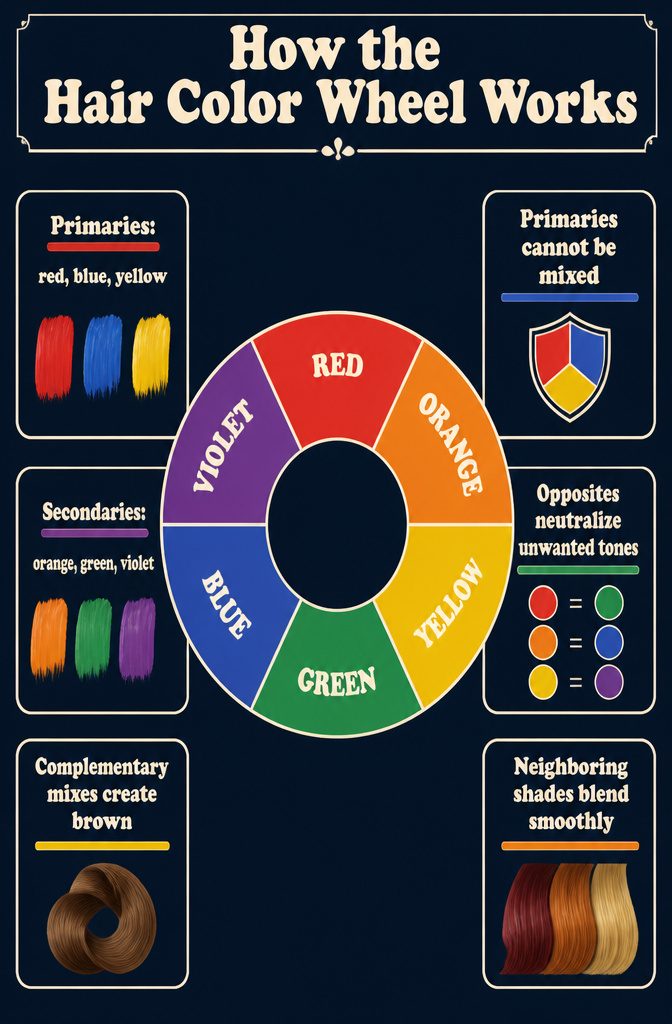
The color wheel starts with three primary colors: red, blue, and yellow.
These cannot be made by mixing other colors. Combine two primaries and you get the secondary colors: orange (red and yellow), green (yellow and blue), and violet (blue and red).
That six-color circle is the tool that predicts what happens when you layer one shade over another or try to fix a tone you didn’t want.
Color theory is the study of how colors interact—how they combine, contrast, and influence one another. It explains what happens when you mix colors or layer them, which is essential for understanding how hair color works.
That interaction matters most when two colors sit opposite each other on the wheel.
Red neutralizes green. Orange neutralizes blue.
Yellow neutralizes violet. Mix complements together and you get brown, which is why purple shampoo works for brassy blonde hair but layering ash toner over yellow can turn things muddy.
Colors next to each other on the wheel blend smoothly, while contrasting ones placed side by side add visible dimension.
Natural Pigment and Your Base
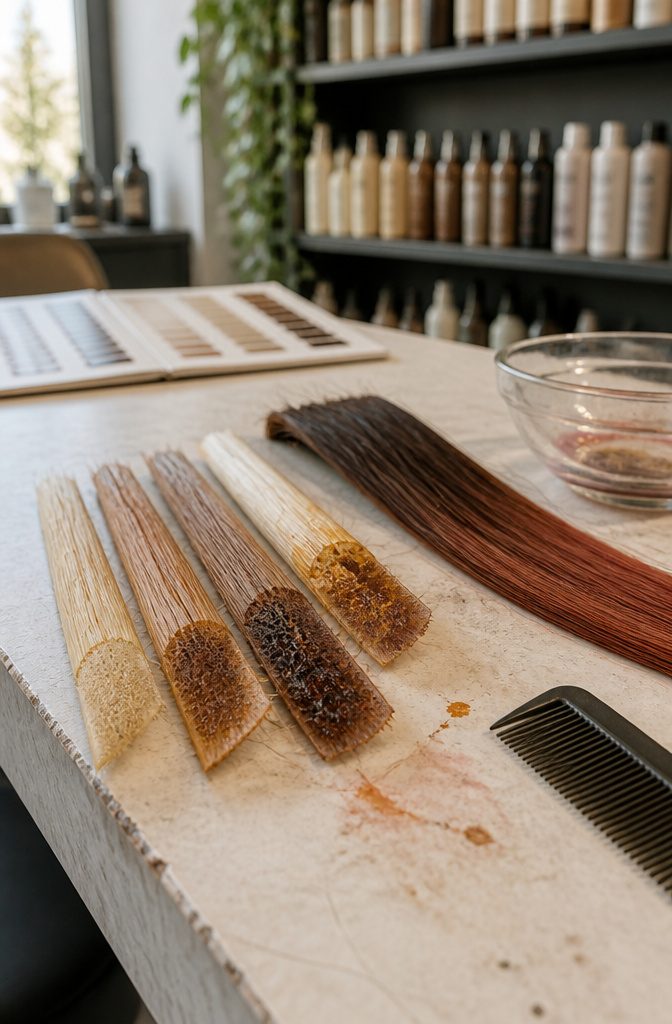
Your hair’s natural pigment sits in the cortex, the middle layer of the strand, and every color result you get is built on top of it.
Two types of melanin do the work: eumelanin provides black and brown tones, while pheomelanin gives you red and yellow. These pigments blend in varying amounts to form every natural shade you see.
Black and brown hair holds a lot of eumelanin. Red hair carries large quantities of pheomelanin.
Light blonde hair contains relatively little melanin, and the pale yellow you see comes more from the keratin in the hair itself than from pigment. White or grey hair has little to none.
If you’ve previously colored your hair, that artificial pigment layers over your natural base.
Both matter when you’re choosing your next color, because dye interacts with whatever is already there. Starting from processed blonde means factoring in how that blonde was lifted and what undertone it left behind.
Starting from faded fashion color means accounting for whatever deposit remains. The base is never neutral, and pretending it is leads to results that surprise in the wrong direction.
Level, Tone, and Undertone
Level, Tone, and Undertone
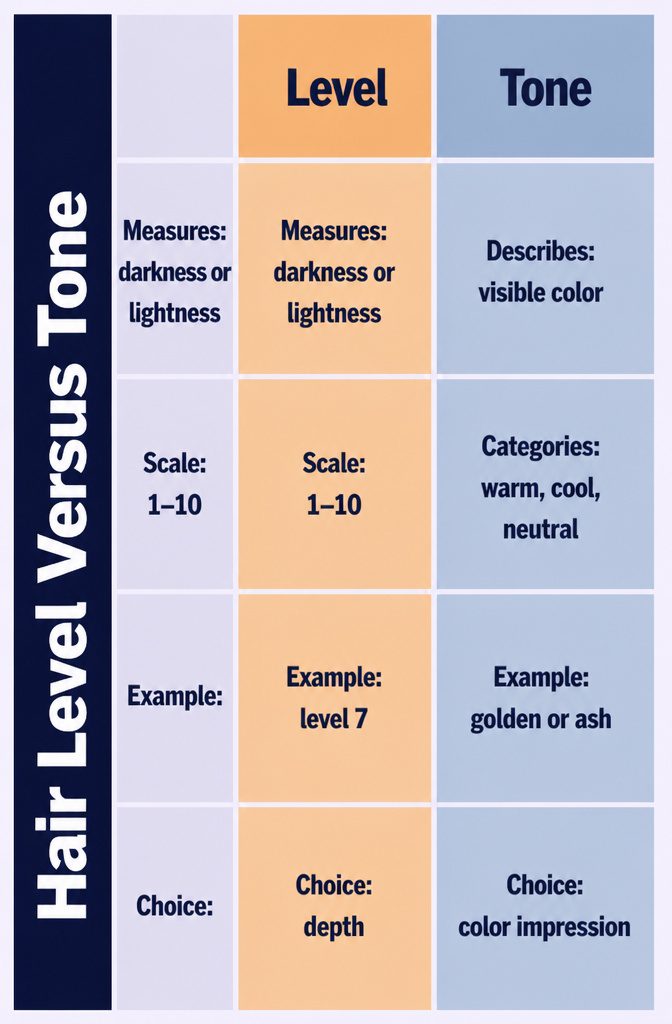
Level and tone are separate decisions, and mixing them up is why so many color results look off.
Level measures darkness or lightness on a 1 to 10 scale: 1 through 3 covers black to dark brown, 4 through 6 runs medium to light brown, 7 and 8 are dark to medium blonde, and 9 to 10 reaches light to very light blonde.
Tone describes the color you actually see—warm, cool, or neutral.
A level 7 can read as warm golden brown or cool ash brown. Same darkness, completely different vibe.
Undertone is the subtle hue beneath your skin, and it guides which tones flatter you. Warm undertones pair well with golden or copper shades, cool undertones look sharp with ash or icy colors.
Check the veins on your inner wrist: greenish veins and a preference for gold jewelry suggest warm, bluish veins and silver jewelry point to cool.
When hair tone matches skin undertone, the whole look harmonizes. Fight it and something reads slightly off, even when the technical work lands perfectly.
Lifting Reveals Warmth
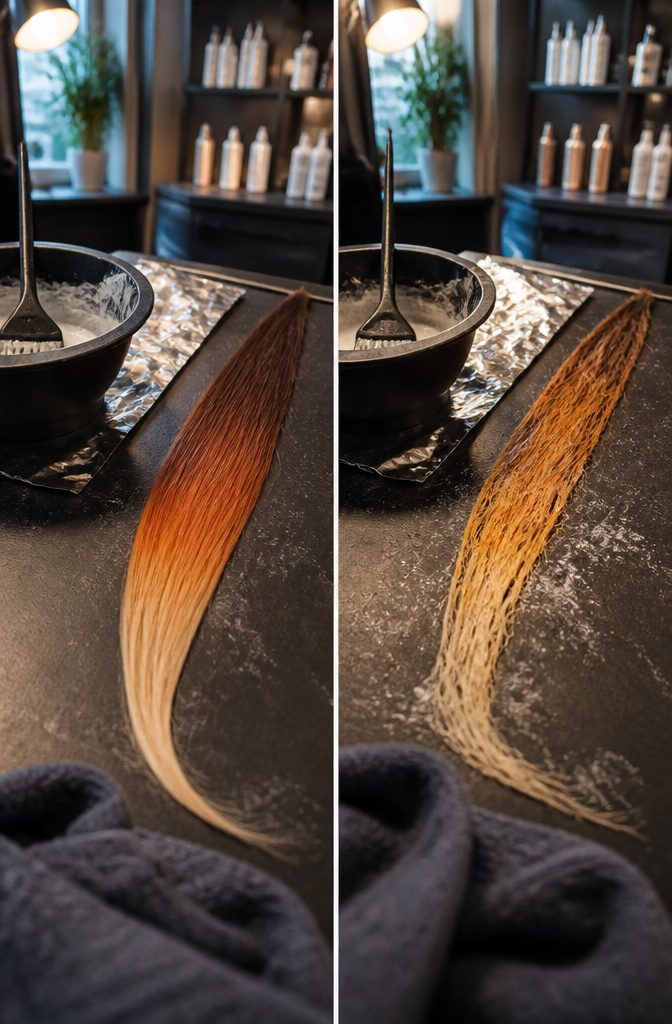
Lightening hair doesn’t just remove color. It exposes the warm pigment that was always there, moving through a predictable sequence: red to orange to yellow to pale yellow.
Someone lifting from a level 4 medium brown to a level 8 blonde will see all of that warmth surface before the hair is light enough to tone. The darker the starting point, the more red and orange contributing pigment waits underneath.
That warmth becomes harder to control the further you lift. When you’re moving more than two levels, your ability to neutralize that underlying orange or yellow weakens.
Color alone can’t take level 4 to a cool level 9, no matter which developer you use. You either need to lift enough to remove the warmth, or you choose a toner that works with what’s left instead of fighting it.
Neutralizing Unwanted Tones
Neutralizing Unwanted Tones
The additive you mix in depends on what you’re trying to cancel.
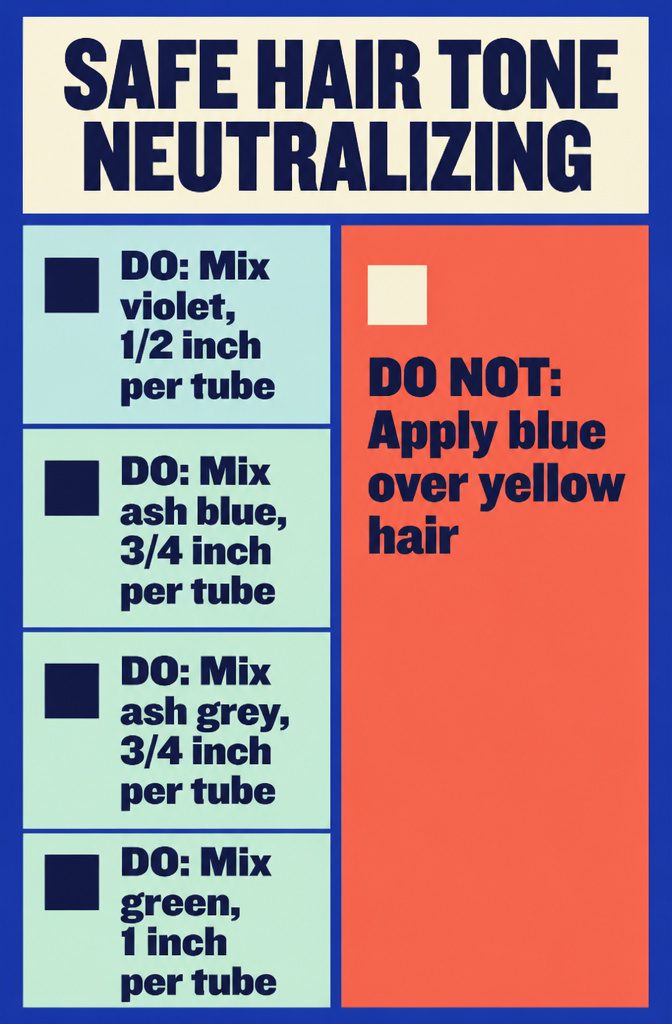
Violet neutralizes yellow, ash blue additive handles yellow-orange, ash grey additive knocks out orange and magenta, and green counteracts red. You mix these with a natural base color (anywhere from 10N down to 6N) rather than applying them straight.
The proportions matter.
Add 1/2 inch of violet to one tube of base for pale yellow tones. For yellow-orange, use 3/4 inch of ash blue additive per tube.
Ash grey additive follows the same 3/4 inch rule for orange and magenta. Red takes more: 1 inch of green per tube of base.
One warning I always give: if you put blue over hair that still has yellow in it, you get green. The color wheel doesn’t pause because you skipped a step.
| Unwanted Tone | Neutralizer | Amount per Tube |
|---|---|---|
| Yellow | Violet | 1/2 inch |
| Yellow-orange | Ash blue additive | 3/4 inch |
| Orange and magenta | Ash grey additive | 3/4 inch |
| Red | Green | 1 inch |
Applying Theory to Your Color
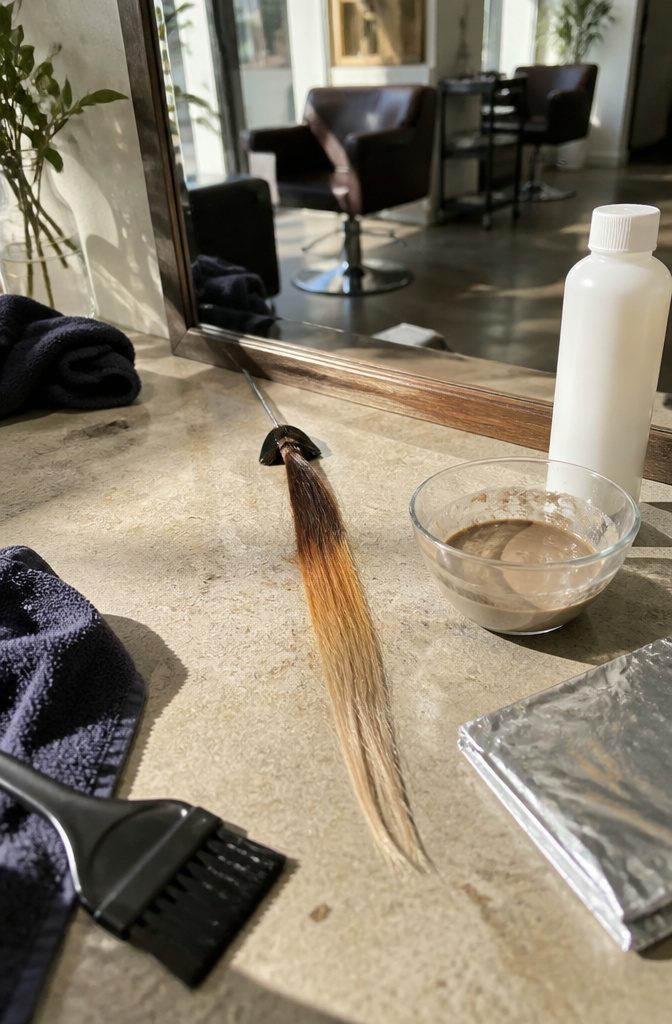
Starting color, desired result, hair condition, and anything you’ve put on it before combine to decide what goes in the bowl.
A formulation that works for one person can fail on another whose hair looks identical at first glance, because lifting capacity depends on developer strength and the underlying pigment you’re working through.
Take someone at a level 5 wanting a level 7 neutral beige with no gray.
The formula would be 7 Ash or 7 Ash/Violet with 20 volume developer, chosen because lifting two levels from 5 to 7 reveals orange and orange-yellow pigment that ash and violet tones can neutralize.
Miss the lift and the warmth wins, which is the usual reason for brassy results.
Previous chemical services, porosity differences, and damage all shift how color processes. Water mineral content matters.
Natural undertone can read warmer than expected. A strand test on an inconspicuous section tells you whether the formula will hold before you commit the whole head.
That step matters more when the hair has been colored before or shows uneven condition, because those are the situations where theory alone can’t predict the result.
Color corrections in Illinois salons run $200–500 or more, which is when paying for a consultation makes sense instead of adjusting the formula yourself at home.
Products and Developer Volume
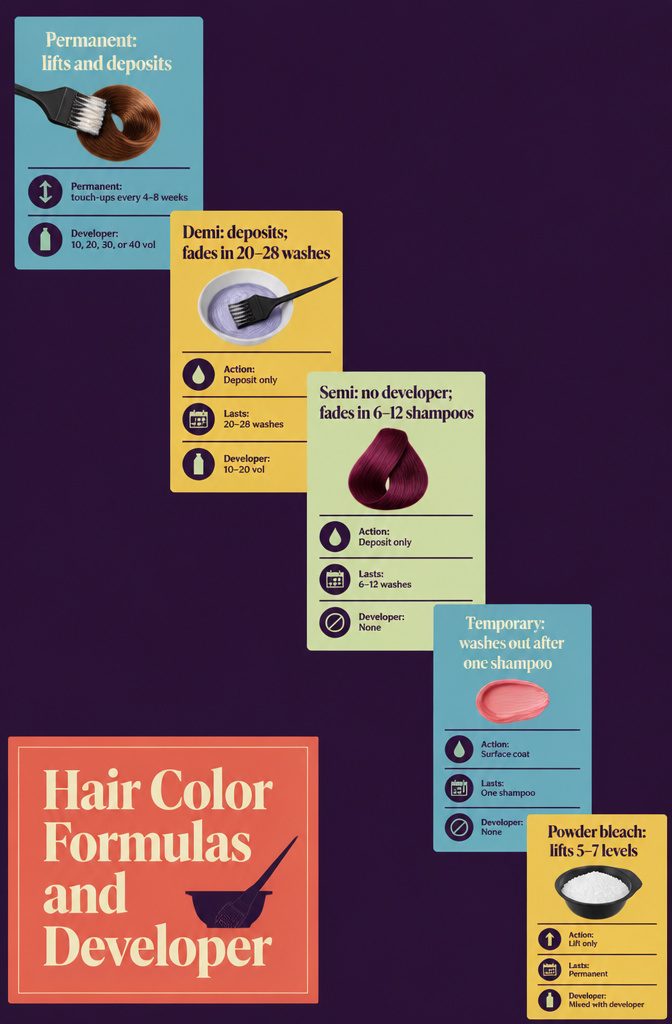
Permanent color mixed with developer is the only formula that both lifts and deposits. It alters the structure permanently, so roots need touch-ups every 4–8 weeks.
Demi-permanent uses low-volume developer (usually 10 or 20 volume) without ammonia, deposits tone without lifting, and fades over 20–28 washes. It’s underrated for its versatility.
Semi-permanent contains no developer or ammonia, coats the surface only, and gradually fades in 6–12 shampoos. Temporary color washes out after one shampoo.
Developer strength determines how much lift you get.
10 volume deposits only, no lifting action. 20 volume lifts 1–2 levels and is the standard strength.
30 volume achieves 2–3 levels, 40 volume goes 3–4. Powder bleach lifts 5–7 levels and is the strongest option when you need serious lightening.
| Type | Lift or Deposit | Lasts | Developer |
|---|---|---|---|
| Permanent | Both | Touch-ups every 4–8 weeks | 10, 20, 30, or 40 vol |
| Demi-permanent | Deposit only | 20–28 washes | 10–20 vol |
| Semi-permanent | Deposit only | 6–12 washes | None |
| Temporary | Surface coat | One shampoo | None |
| Powder bleach | Lift only | Permanent | Mixed with developer |
Reading Box Numbers
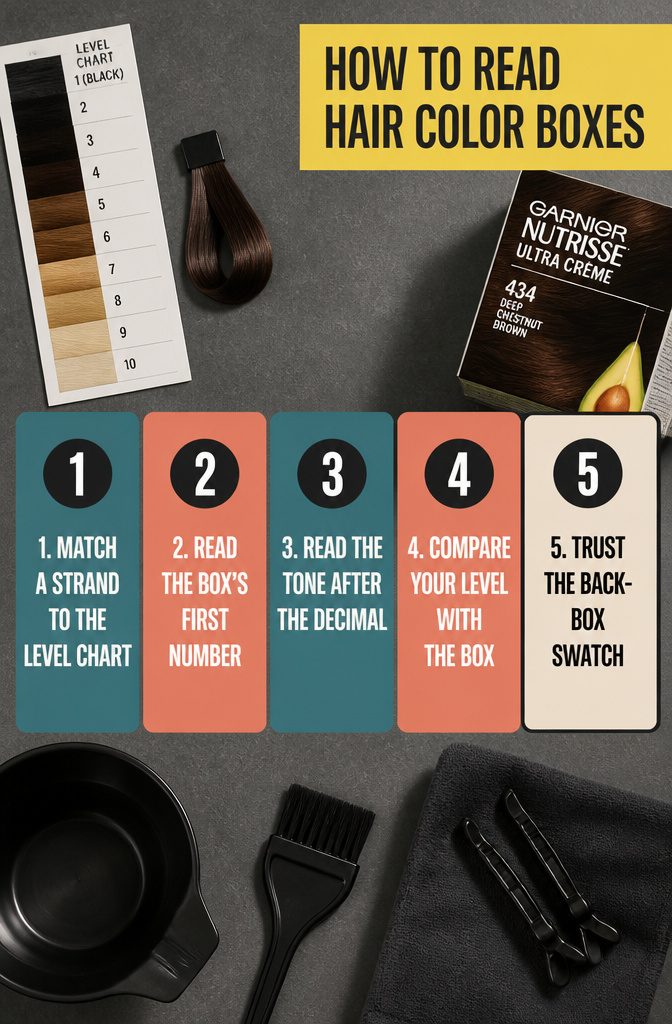
- Pull a clean section of hair away from the rest and hold it against a level chart in natural daylight or under bright white light. Match the depth of that strand to the numbered scale running from 1 (black) to 10 (palest blonde). That number is your starting level.
- Find the first number on the box. Garnier Nutrisse Ultra Crème 434 Deep Chestnut Brown uses 4 as the level, placing it in the dark brown range. A box marked 5.3 sits at level 5, medium brown territory.
- Check the number after the decimal or slash for tone. In a 5.3 formula, the 3 signals a golden tone. The higher that second number, or the more times it repeats, the stronger the warmth or cool the formula deposits.
- Compare your level to the box level. Going more than two shades lighter or darker usually calls for salon lifting or pre-lightening, but a jump of one or two levels works at home.
- Use virtual try-on tools and brand quizzes if you need a second opinion on tone, but trust the swatch chart on the back of the box over the model shot on the front.
Porosity and Color Uptake
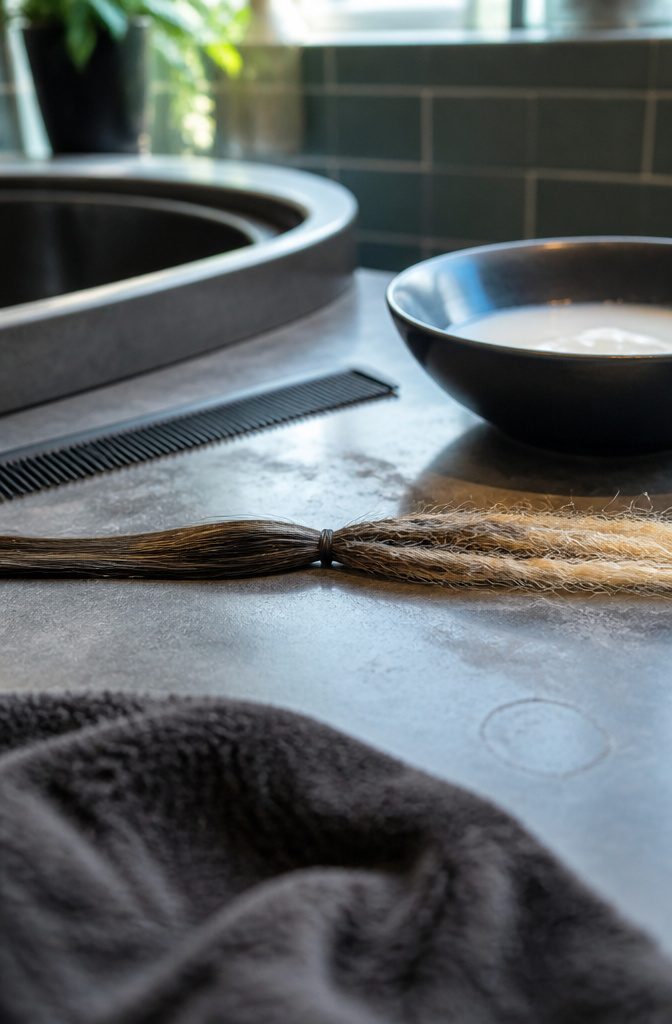
Hair strands are built in three layers: the cuticle (outer protective layer), cortex (middle layer where pigment lives), and medulla (inner core, sometimes absent in fine hair).
Porosity is about the cuticle. In healthy, untreated hair, the cuticle lies flat and tight, which means color has a harder time getting in but stays put once it does.
Damaged or over-processed hair has a lifted, open cuticle that grabs color fast but loses it just as quickly.
High porosity hair can look darker than you planned right after coloring, then fade within days. Low porosity hair needs longer processing time and sometimes a higher volume developer to get color to take at all.
If you’ve bleached your ends or used heat tools daily for years, those sections are far more porous than your roots, which means they’ll pull color differently from the same formula.
Pre-filling with protein or using a color filler before applying your target shade keeps porous hair from turning patchy or fading unevenly.
Dimension and Placement Techniques
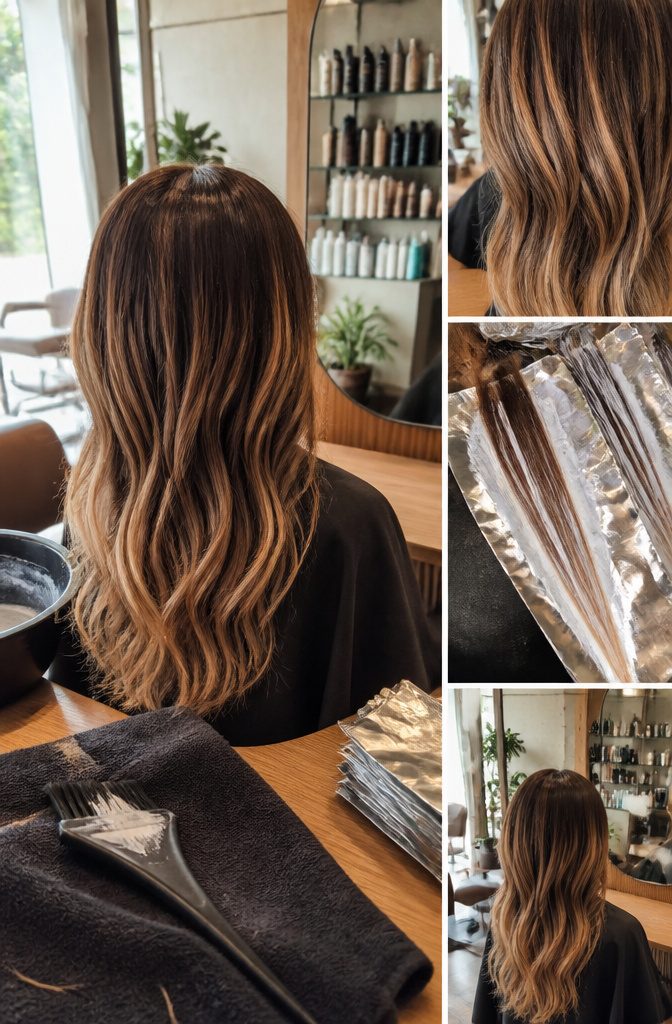
Single-process color coats every strand with one shade, and it reads flat in most light because there is no variation for the eye to catch. Highlights and lowlights break that sameness by adding lighter and darker pieces through the base.
Highlights lighten sections to create dimension, while lowlights add depth with darker tones. A brunette base gains movement with caramel ribbons, and a cool blonde gets richer with soft beige lowlights woven through.
Balayage hand-paints highlights for a natural, sun-kissed look, and ombre builds a gradual shift from dark roots to lighter ends. Both lean on low-maintenance grow-out, which matters if you are not touching up every six weeks.
Vivid shades need a pale canvas. Arctic Fox and similar dyes work best on level 9 or higher, otherwise the color muddies.
When the hair lifts to orange or yellow, a diluted blue or violet pre-dye cancels the warmth before the final shade goes on. Blue neutralizes orange, violet handles yellow.
Frequently Asked Questions
Does hair color theory work on hair?
Yes. The color wheel predicts what happens when you layer one shade over another or try to correct a tone you don’t want.
It only holds up if you account for your starting level, any previous color, and how far you are lifting.
Run a strand test first, since theory alone can’t predict the outcome on hair that has been colored before or is unevenly damaged.
What is the hair color wheel?
It is a six-color circle used to see how shades combine and cancel each other.
Red, yellow, and blue are the primaries, and mixing two of them gives the secondaries: orange, green, and violet. Colorists use it to predict how a new shade will sit over what is already in the hair.
What are complementary colors in hair color?
They are colors directly opposite each other on the wheel: red and green, orange and blue, yellow and violet.
Opposites neutralize one another, and mixing them produces brown. That is why purple shampoo cancels brassy yellow in blonde hair.
What level is my hair color?
Separate a clean section of hair and hold it against a level chart in natural daylight or bright white light.
Match its depth to the scale, which runs from 1 (black) to 10 (palest blonde). That number is your starting level.
How do I figure out what tone I want?
Start with your skin’s undertone: warm undertones suit golden or copper shades, and cool undertones suit ash or icy shades. Then use the color wheel to decide whether you need to add a tone, cancel one, or make it stronger.
A level 7, for example, can be a warm golden brown or a cool ash brown, so pick the tone separately from the darkness.
What is a natural undertone?
It is the subtle hue beneath the surface of your skin, and it affects how a hair color looks against your complexion.
Greenish wrist veins and a pull toward gold jewelry suggest a warm undertone. Bluish veins and a preference for silver suggest a cool one.
Which colors or toners cancel yellow, orange, and red?
Violet cancels yellow, ash blue additive handles yellow-orange, ash grey additive neutralizes orange and magenta, and green counteracts red. Each one sits opposite the unwanted tone on the color wheel.
How much neutralizer do I mix with my base color?
Mix the additive into a natural base color (10N down to 6N) instead of applying it alone.
Per tube of base, use 1/2 inch of violet for pale yellow, 3/4 inch of ash blue additive for yellow-orange, 3/4 inch of ash grey additive for orange and magenta, and 1 inch of green for red.
Can I tone brassy, orange, or yellow hair without bleach?
Toner can cut the warmth, but it won’t give you the white-blonde result that bleaching does.
Toning also works best when the hair has been lifted far enough first, because neutralizing gets weaker the further you move past two levels. Without enough lift, you are asking the toner to fight a lot of leftover pigment.
Why does my hair still pull orange or brassy after toning?
The hair most likely needs more lift before you tone.
Lightening moves through red, orange, yellow, and pale yellow, and dark hair has a lot of red and orange to work through. Keep lifting until the warmth is gone, or choose a toner that works with the tone that remains.
Why did my toner turn my hair green?
A blue-based toner, such as an ash shade, went onto hair that still had too much yellow in it, and blue plus yellow makes green.
Lift the hair one more level, or switch to a violet-based toner that cancels the yellow.